

Key takeaways
- A curved screen sits further off the wall than a flat one. The panel edges stand proud, so allow more clearance and expect the profile to read deeper from the side.
- Curved panels reward a narrow seating arc. The curve is calculated for someone sitting centrally — the further off-axis you sit, the more the geometry works against you.
- Tilt is useful, extreme tilt isn’t. A small downward angle helps a high screen. Heavy tilt on a curved panel distorts the picture geometry and increases reflections.
- Curved sets show glare differently. The curve gathers reflections from a wider arc of the room, so a window opposite the screen is more of a problem than it would be on a flat panel.
- Support matters more, not less. Curved sets are often larger and heavier, and the extra standoff increases leverage on the top fixings. Studs or masonry only.
Samsung stopped making curved TVs after 2019, and the rest of the market followed within a year or two. If you're shopping for a new TV today, curved isn't really on the menu — it's flat, or it's nothing. If you already own one, none of that matters to you. Plenty of GTA living rooms still have a curved Samsung or LG sitting on a stand, and the question isn't whether to buy one. It's how to get the one you already own safely up on the wall.
The good news: it's not a different job. It's the same job with a handful of extra things a flat panel never makes you think about — how far the screen actually sits off the wall, what the VESA holes look like on a bowed rear panel, and how much your seating arrangement matters once the screen is fixed in place.
- Wall gap
- A curved panel's edges stand further off the wall than a flat screen's, even on a low-profile mount.
- VESA holes
- Often recessed, or set into a slightly bowed rear panel. Check before you buy a mount, not after.
- Best seat
- Centred and fairly close-in. Off-axis viewing degrades faster on a curved screen than a flat one.
- Above a fireplace
- Possible, but a flush fixed mount tends to emphasise the curve badly on a wall people walk past.
- Concrete or steel stud
- Common in Toronto condos. The extra standoff adds leverage on the top fixings, so hitting structure matters more, not less.
- Full-motion vs fixed
- An articulated arm hides the standoff and gives you the seating flexibility a curve actually rewards.
Do Curved TVs Need a Special Wall Mount?
Not a special category of mount — almost every curved TV still uses the same VESA hole pattern as a flat one, measured the same way, width by height in millimetres. What changes is what's around those holes. Some curved sets recess the mounting points into the chassis, and a few curve the panel enough right behind the screws that a bracket sitting flush against the back would load the plastic trim instead of the metal frame the holes are meant to grip.
That's what spacers are for. A few manufacturers publish which of their own mounts are validated for curved panels, which is the fastest way to be sure — but you can check it yourself before you spend anything.
- Find the VESA pattern on the panel. It's on a label on the back, or in the manual — width by height in millimetres, same as any flat TV.
- Check the mount's supported range against it. A pattern outside that range means the bracket's arms won't reach, curve or no curve.
- Look at the back of the panel around the holes. Recessed points or a noticeable curve right at the fixings means you'll need spacers so the plate doesn't bridge unevenly.
- Dry-fit before you commit. Thread the screws through the spacers and the bracket arm without drilling anything, and confirm they seat fully without bottoming out.
How Far Off the Wall Does a Curved TV Sit?

Even a slim fixed mount that sits nearly flush at the centre of a curved screen leaves a real gap at the edges, because the panel itself curves away from the wall on both sides. A full-motion arm hides this by design — the mount was never flush to begin with — but a fixed or tilt-only bracket puts that gap on display, and it's more noticeable the bigger the screen and the tighter the curve radius.
Leave slack in your cable run
Plan your cable length for the deepest point of the standoff, not the shallowest. A curved panel sits further from the wall at the edges than the centre, and a power or HDMI cable measured to the middle of the plate can come up short once the TV is actually hanging.
Where Should You Sit for a Curved TV?
Centrally, and within a narrower arc than you'd think. The curvature is calculated around one viewing position, and the geometry works against you faster the further you move off it — more so than on a flat panel, where the picture just gets dimmer at an angle instead of visibly distorting. Past roughly 30–35 degrees off-centre, the near edge of a curved screen starts to look foreshortened against the far edge, and it happens quickly rather than gradually.
That single-viewer bias matters for room layout. A sofa facing the screen square-on gets the benefit the curve was designed for. A sectional or a second chair off to one side gets less of it — sometimes less than a flat panel would have given that same seat.
Glare behaves differently too. A curved screen gathers reflections from a wider slice of the room and can concentrate them, so a window or a lamp that wouldn't bother a flat screen can show up clearly on a curved one. Where you can, position the screen perpendicular to your main light source rather than facing it.
Can You Mount a Curved TV Above a Fireplace?
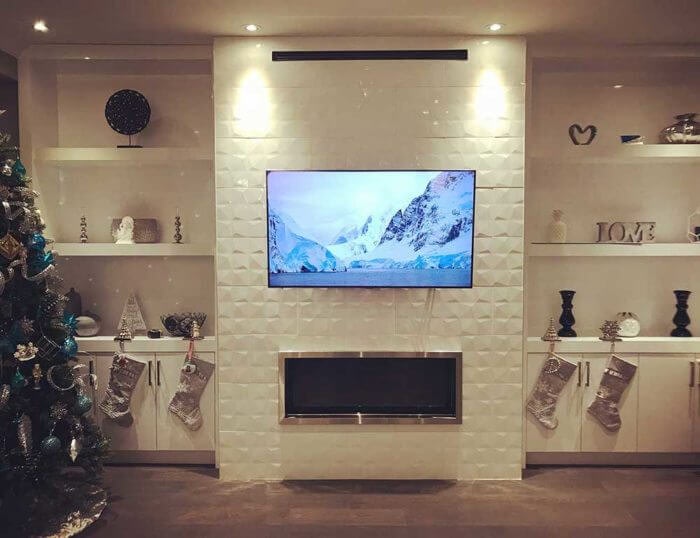
You can, but it's the least flattering spot for one. Fireplace walls put the screen above natural eye level, which calls for tilting it down to compensate. Tilt changes the geometry of a curved panel more than it does a flat one, and heavy tilt on a curved screen distorts the picture and can add reflections rather than remove them.
Keep tilt minimal on a curved panel
A little downward tilt to relieve neck strain is fine. Pushing it further to compensate for a screen mounted too high fights the curve's own geometry and undoes the reason you'd want a curved panel in the first place. If the fireplace wall is your only option, a pull-down or height-adjustable mount that brings the screen to eye level for viewing works better than tilt alone.
There's a second issue specific to open-plan living rooms: a fireplace wall is often visible at an angle from the kitchen or a hallway, not just from the sofa. A flush fixed mount puts the curved profile on show from that side angle all day, walked past rather than watched. It's cosmetic, not a safety issue, but it's worth knowing before you commit to a fixed bracket in that spot.
Can You Mount a Curved TV on Concrete, Steel Studs or Drywall?

Yes, on all three, and the fixing method depends entirely on the wall rather than on the TV being curved. What the curve does change is how much that fixing has to hold: curved sets tend to run larger and heavier than the flat panel that replaced them in the catalogue, and the added standoff increases the leverage on the top fixings. A wall that would comfortably hold a flat screen of the same weight can still be marginal for a curved one sitting further out from it.
| Wall type | What holds it | Why it matters here |
|---|---|---|
| Poured concrete (most Toronto condos, 1990s onward) | Sleeve anchors driven into the concrete itself | The strongest fixing available, but unforgiving — there's no repositioning once a hole is drilled. |
| Steel stud drywall (condo partition walls) | Fasteners rated for the mount's combined load, sized to the stud gauge | A magnetic stud finder locates steel studs reliably. Don't assume drywall means no stud behind it. |
| Wood stud drywall (older Toronto houses) | Lag bolts into the studs | Older homes have less predictable stud spacing than new-build framing — confirm with a knock test, not just the finder. |
Whichever wall you've got, our guide to fixed, tilting and full-motion brackets covers which mount type actually suits the room, and our troubleshooting guide is worth a look if something about an existing install feels off rather than new.
When to Call a TV Mount Installer
Handle it yourself if you're comfortable with a stud finder and a drill, the wall is straightforward drywall over wood studs, and the TV is a size you can lift and hold steady on your own while you fix it. Call someone when you're into concrete or steel studs, when the set is large enough that one person can't safely manage it during the hang, when the wall has already failed a fixing once, or when you want the extra spacers and standoff calculated properly rather than guessed at.
GTA TV Wall Mounting has been mounting TVs — curved, flat and everything in between — across Toronto and the surrounding GTA service areas for years. We carry $2,000,000 commercial liability insurance, we're up to 50% less than comparable big-box store installation services, and every job comes with a one year material and workmanship warranty. If you're not sure whether your old curved set needs anything special, send us the model number and we'll tell you before we book anything.
Frequently Asked Questions
Do curved TVs need a special wall mount?
Not a special category, but the mount has to clear the curve. Check that the bracket's arms and the wall plate don't foul the panel's shape, and that the VESA pattern matches.
Many manufacturers list which of their mounts are validated for curved panels — that's the quickest way to be sure.
How far from the wall will a curved TV sit?
Further than a flat panel of the same size, because the edges of the screen stand away from the wall even when the centre is close. Plan for that when you're deciding between a slim fixed mount and a full-motion arm.
Where should people sit for a curved TV?
Centrally, and within a fairly narrow arc. The curvature is designed around a central viewer, so a room with seating spread wide across the wall gets less benefit from it than a room with a single main sofa facing the screen.
Is glare worse on a curved screen?
It behaves differently. A curved panel collects reflections from a wider portion of the room and can concentrate them, so a lamp or window that wouldn't trouble a flat screen can show up clearly. Position the screen perpendicular to your main light source where you can.
Can a curved TV be mounted above a fireplace?
You can, but it's the least flattering position for one. The screen ends up high, which needs downward tilt, and tilt is exactly what a curved panel handles least well.
If the fireplace wall is the only option, a pull-down mount that brings the screen to eye level for viewing is the better answer.
Can a curved TV be mounted on drywall?
Yes, with the bracket fixed into the studs behind it. Curved sets are often larger and heavier, and the extra standoff increases the leverage on the top fixings — so hitting structure matters more here, not less.
Are curved TVs harder to install than flat ones?
Slightly. The extra depth, the added weight and the tighter tolerance on bracket clearance all make the job less forgiving. The fixing principles are identical — find the studs, use the right hardware and check level twice.