

Key takeaways
- Get permission in writing before you drill. Most leases treat wall mounting as an alteration. An email reply from your landlord is enough, and it settles the question up front.
- Photograph every wall before you start. Time-stamped photos of the existing condition are the cheapest insurance you can get against a damage claim.
- A TV mount goes into studs, never into drywall alone. Drywall anchors aren't rated to carry a television. Framing is typically 16” on centre, sometimes 24”.
- No-drill options exist and they work. Floor-standing TV stands and tension-pole mounts give you the mounted look with zero holes — the usual answer when permission is refused.
- The patch is easier than people expect. Four lag-bolt holes fill with spackle, sand flush and take touch-up paint. Note the paint colour when you move in, not when you move out.
Renting doesn't rule out a mounted TV. It just changes the order of operations: permission before drilling, a mount that keeps the hole count honest, and a plan for putting the wall back the way you found it. Get those three right and the move-out conversation stays short.
- Permission
- Get it by email or text before you drill anything. A verbal yes doesn't hold up at move-out.
- Typical hole count
- Four lag-bolt holes for a standard bracket. A wide-rail plate can bring that down to two.
- What's normal wear
- Filled, sanded and repainted holes, once consent is on record.
- What isn't
- Unfilled holes, mismatched touch-up paint, or a chunk of drywall pulled out with an anchor.
- Condo walls
- Often poured concrete behind the drywall. Check the condo corporation's rules before drilling into anything structural.
- Patch time
- About 20 minutes of hands-on work once the mount is off — the paint cure is what actually takes time.

Get Landlord Permission in Writing Before You Drill Anything
A phone call or a hallway "sure, go ahead" doesn't exist anywhere your landlord can be held to it later. Email is enough — you're not drafting a legal document, you're creating a timestamp. Say what you want to mount, roughly how big the TV is, and that you'll patch and repaint the holes when you move out. Ask for a one-line reply confirming it's fine. That's the whole exchange, and it's the single thing that turns "did they damage the wall" into "was this agreed to" if your landlord ever raises it.
Photograph the wall before you touch it — the blank stretch, the outlet, the baseboard, all in one wide shot with a timestamp. It costs nothing and it's the only evidence that shows what the wall looked like before, not just after.
What Actually Counts as Damage at Move-Out
Landlords who deal with tenants regularly aren't shocked by wall-mount holes. What they push back on is holes that were never dealt with, or a patch job that's obviously a patch job from across the room. The line between the two is narrower than people assume.
| What you did | Normal wear and tear |
|---|---|
| Four lag-bolt holes, filled, sanded and repainted to match | Yes, once permission is on record |
| Holes left unfilled, or bigger than the bolt that made them | No — likely charged back |
| Patch visible under raking light or as an off-colour square | Borderline — feather the paint, don't spot it |
| Drywall anchor pulled out, taking a chunk of gypsum with it | No — that's a repair, not a touch-up |
| Surface raceway removed, paint underneath untouched | Yes |
The pattern is consistent: reversible and quietly fixed passes, visible and unaddressed doesn't. Everything below is aimed at staying on the right side of that line.
Pick a Mount That Keeps the Hole Count Down
A standard fixed or tilting bracket uses four lag bolts into two studs — that's the baseline, and it's a small, patchable footprint on its own. If you want fewer holes than that, look at a mount with a single central plate rather than a full-width rail; some fix into one stud with two bolts instead of four across two. The tradeoff is less side-to-side placement flexibility, so measure the stud location before you buy rather than after.
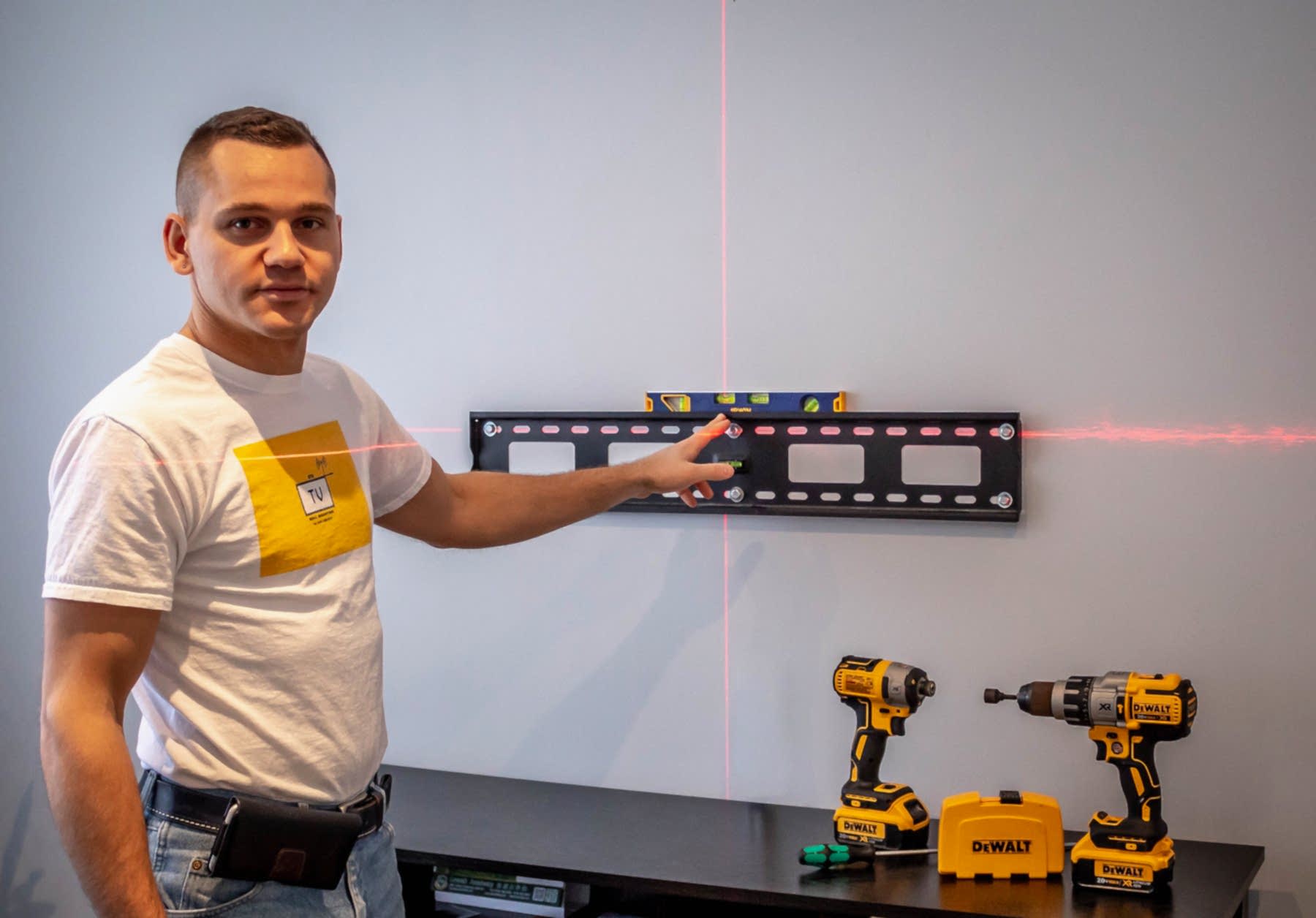
Studs only — no exceptions for rentals
Drywall anchors aren't rated to carry a television regardless of whose wall it is. A mount is a lever, and the load on the top fixings climbs as the screen tilts forward. Find the stud, or don't hang the TV there.
Whatever bracket you land on, our guide to choosing the right mount for your space covers fixed, tilting and full-motion options in more depth than a rental post needs to.
Toronto Condos and Older Houses: What's Actually Behind the Wall
A lot of GTA rentals aren't simple drywall-over-stud construction. Condo demising walls are frequently poured concrete behind a thin layer of drywall or furring strips, which changes the tool and the fastener — a hammer drill and a sleeve anchor, not a cordless driver and a wood screw. Concrete takes an excellent fixing once you're set up for it, but check your condo corporation's rules first: many restrict drilling into structural walls, and some want notice before any work starts, separate from your landlord's own sign-off.

Older Toronto houses swing the other way: framing that isn't a tidy 16 inches on centre, plaster-and-lath in place of drywall on pre-war builds, or steel studs in a more recently renovated unit. A stud finder reads density, so it can't tell timber from a pipe or a seam — confirm with a knock test before you commit to a mark.
If Your Landlord Says No
Sometimes the answer is a flat no, and there's a reasonable route that doesn't involve arguing about it. A floor-standing TV stand with a mounting pole gives you the same floating look with zero wall contact, and a tension-pole system that braces between floor and ceiling does the same job without a base taking up floor space. Both come down and go with you at the end of the lease. Our roundup of wall-mount alternatives covers the full range if a stand isn't quite what you pictured.
Patching the Holes Properly When You Move Out
This is the part people psych themselves out of, and it's the easiest step in the whole process.
- Back the lag bolts out. Support the plate as the last one comes free so it doesn't drop and chip the surrounding paint.
- Fill each hole. Lightweight spackle, applied slightly proud of the surface so it doesn't shrink into a dimple as it dries.
- Let it cure fully. Rushing this step is why patches show later — check the tub's stated cure time rather than guessing.
- Sand flush. Fine-grit paper, light pressure, working outward from the centre of the patch.
- Feather the touch-up paint. Blend outward from the patch rather than painting a hard-edged square — a visible rectangle reads as a cover-up even when the colour is correct.
- Photograph the finished wall. Same framing as your move-in photos, so there's a clear before-and-after on record.
Note your wall colour when you move in, not when you're staring at four holes on your last weekend in the unit — matching paint from memory is the part that actually goes wrong.
Is It Worth Hiring Someone for a Rental Install?

Honestly, plenty of rental installs are a fine weekend project: drywall over wood studs, a straightforward bracket, no cable routing through the wall. Where it's worth paying someone is concrete or brick, plaster-and-lath that cracks if you drill it wrong, or when you want the cable run concealed without cutting into anything you'll have to explain later. Our invisible wire concealment and precision TV installation services are built around exactly that — get it right the first time, and there's nothing to trace back at move-out beyond the patch. If a mount ever comes loose or sits crooked partway through the lease, our troubleshooting guide walks through the fix before you assume the worst.
GTA TV Wall Mounting works across Toronto and the surrounding GTA service areas, carries $2,000,000 commercial liability insurance, and backs every job with a one year material and workmanship warranty. Not sure whether your landlord's sign-off covers what you're planning, or whether your wall is drywall or something tougher? Get in touch and we'll tell you what you're actually working with.
Frequently Asked Questions
Can you mount a TV in a rental without trouble at move-out?
Yes, with written permission and a proper patch at the end.
Get the go-ahead by email, photograph every wall before you start, and note your wall colour while you can still match it. With consent on record and the holes properly filled and painted, there is very little left to dispute.
How do I mount a TV without drilling holes?
A floor-standing TV stand with a mounting pole gives you the same floating look and needs no wall fixing at all. Tension-pole systems that brace between floor and ceiling are the other common route.
Both are the standard answer for renters, condos with concrete or party walls, and anyone whose landlord has said no.
Can I mount a TV in a condo with concrete walls?
You can, and concrete makes an extremely strong fixing — it needs a hammer drill, the correct masonry bit and sleeve anchors rated for the load.
Check your building's rules first. Many GTA condo corporations restrict drilling into structural walls and ceilings, and some require notice before any work starts.
Can I use drywall anchors instead of finding studs?
No. Drywall anchors aren't rated to carry a television, and a mount is a lever — the load on the top fixings increases as the TV tilts forward. Fix into studs, or into concrete or brick with the correct masonry anchor.
What if the studs aren't where I want the TV?
Use a mount with a wider rail so you can hit the studs that exist while keeping the screen centred where you want it. Full-motion mounts also let you shift the screen sideways after installation.
The other option is a mounting plate spanning two studs, which gives you a continuous surface to position the bracket anywhere along it.
How do I hide TV wires in a rental?
Paintable surface raceway. It fixes to the wall, takes the same paint as the surrounding surface and peels off cleanly at the end of a tenancy — no cutting, no permission needed for in-wall work.
How do I patch the holes when I move out?
Back the bolts out, fill with lightweight spackle slightly proud of the surface, let it dry, sand flush and touch up with matching paint. Note your wall colour when you move in — matching it later is the hard part, not the filling.
Is it worth hiring someone for a rental install?
It is if the wall is concrete, brick or plaster and lath, or if you want the cables concealed without cutting anything permanent. We work across the GTA and carry a one year material and workmanship warranty.